
THE GLOWING ORACLE | SHOW US THE BILL — REGIONAL CASE STUDY
Evidence snapshot: November 21, 2026. Stage: preliminary developer proposal; no formal site-plan application identified in the records reviewed.
Global Common’s Geer Street concept is still a proposal, not an approved data center. Its potential benefits and its environmental footprint therefore remain promises and open questions. This review separates the company’s own design claims from measurements, permits and enforceable obligations that do not yet appear in the public record reviewed here.
Project status and scale
The site is approximately 159 acres at 51 and 79 Geer Street. The company’s November 16 concept plan revises the layout shown in its November 3 overview. The current project FAQ estimates about 40 MW of IT load in Phase 1 and up to 240 MW at full buildout. Those figures cover computing equipment, not total facility electricity demand or grid imports. The company proposes keeping more than 70% of the property undeveloped and preserving about 20 acres as farmland and open space. These are design proposals, not recorded easements or final permits.
Global Common says it expects to file a site-plan application in early 2027. Cromwell’s Planning and Zoning Commission minutes record two separate zoning matters scheduled for December 3: a resident zoning-text amendment (#26-37) and a six-month moratorium proposal (#26-41). These are hearings, not an enacted moratorium or approval of the Geer Street site. Check the final town notice for meeting details.
Electricity: onsite generation still needs a full accounting
The developer proposes natural-gas fuel cells supplied from a nearby gas transmission line, with a microgrid and possible heat recovery. It says this could reduce grid reliance and avoid backup diesel generators. That is a design proposal, not proof of fuel-cell output, emissions, reliability or grid independence. Any export, supplemental imports, outage behavior, gas use and carbon accounting need to be disclosed and independently reviewed.
Global Common’s Community Power Program proposal would use project revenues to cover electricity supply charges for households that voluntarily enroll through a licensed supplier. The company estimates supply accounts for about 47% of a residential bill; Eversource delivery and other charges would continue. The program would expand as the project grows, and the company proposes formalizing the commitment in a host agreement. Separately, its FAQ estimates more than $8 million in annual municipal revenue at full buildout, while the November 3 overview says more than $10 million. No signed agreement or common calculation reconciling those figures was identified. Neither the bill savings nor the municipal revenue is guaranteed.
Water: “closed loop” does not close the question
The materials reviewed do not establish the facility’s water source, annual makeup-water demand, peak summer use, evaporative consumption, blowdown, wastewater path or drought operating plan. A closed-loop system can reduce water use, but does not by itself quantify makeup water or explain how heat ultimately leaves the campus. Obtain the cooling design, water balance and discharge approvals before assigning a footprint.
Noise, air and the school
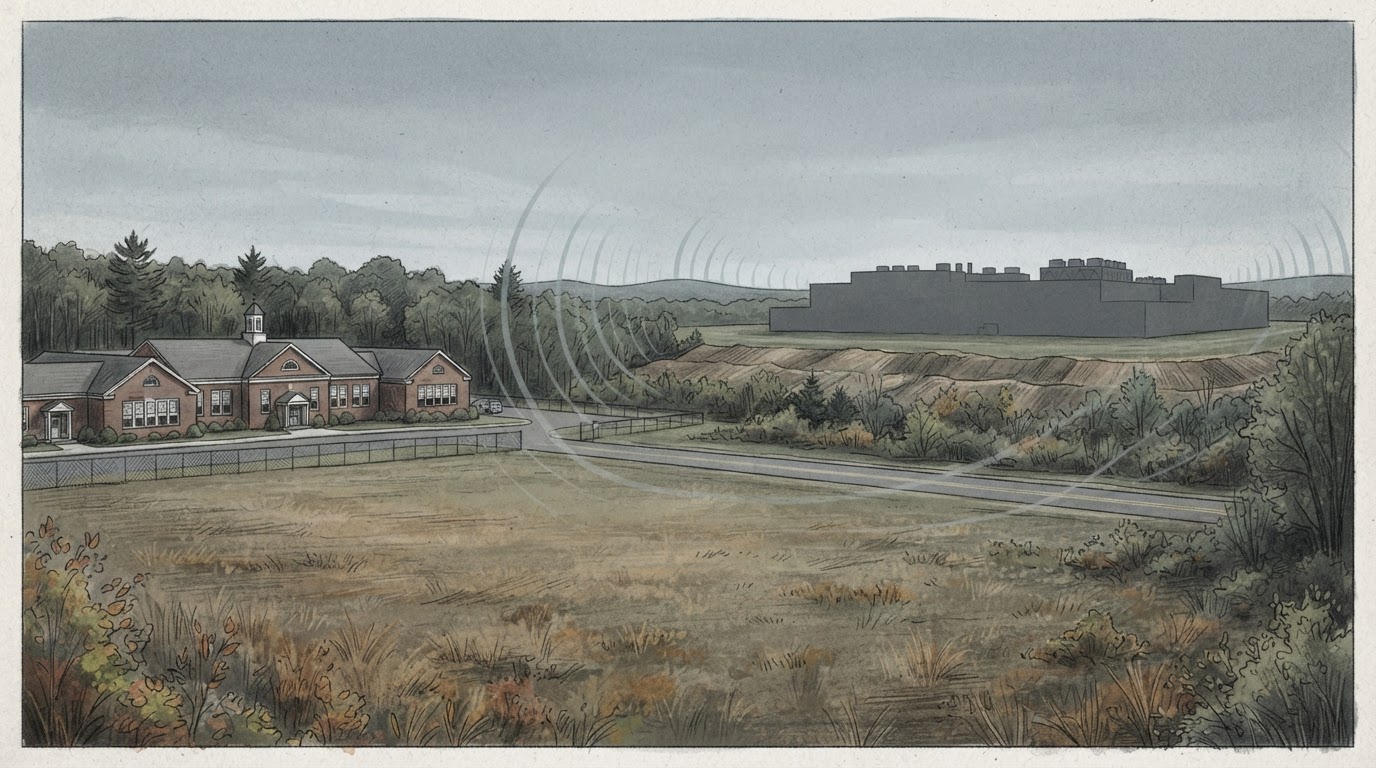
The November 3 overview put the closest equipment more than 600 feet from Cromwell Middle School under the earlier layout. In its current FAQ, Global Common places Phase 1 more than 2,000 feet from the school and separately says the nearest equipment would be more than 1,200 feet away after successful completion of Phase 1. Those figures describe different parts or stages of the design shown in the revised concept plan; none is an independently verified measurement or a binding setback. The company says it plans an independent acoustic study during design and permitting, then post-construction testing before further phases. No completed study or operating measurements were identified. Fuel-cell and cooling noise, transformers, gas-system emissions and construction impacts still require review.
The developer’s November 3 document describes claimed 80–90% overall efficiency with heat recovery. That estimate depends on heat actually being captured and used; the document says school heating is only possible if feasible. Treat the efficiency and community heat benefits as design claims until a detailed energy balance and enforceable delivery agreement are available.
Show Us the Bill — evidence status
- Electricity and grid costs: Partial — developer proposes gas-fueled onsite generation and a microgrid; verified load, fuel, emissions, imports/exports, reliability and cost allocation are not established.
- Water and wastewater: Not documented — no public site-specific source, water balance, seasonal demand or discharge pathway found.
- Noise: Not documented — design mitigation is proposed; completed acoustic study and measurements are not available in the reviewed record.
- Land and open space: Partial — company-proposed layout and preservation commitments are not yet final recorded instruments.
- Taxes, household savings and jobs: Claimed, not secured — host fees, electric-bill reductions, tax revenue and job totals require a signed agreement, transparent assumptions and compliance reporting.
- Approval: Not approved — no formal site application found in the latest reporting reviewed; zoning and any moratorium process remain active.
Records needed before a decision
Request the complete current site plan; gas-service and fuel-cell specifications; hourly power balance and emissions inventory; grid interconnection and cost-allocation records; water source, seasonal balance and wastewater plan; independent day/night acoustic model at homes and Cromwell Middle School; construction traffic plan; fiscal analysis; and draft host/community agreements with minimum guarantees and successor-owner obligations.
Missing data are not evidence of zero impact, and community concerns are not measured violations. The next version of this case should update the December 3 hearing outcome and replace each unknown with a dated primary record when one becomes public.
Sources
- Global Common, “Site Layout and Open Space,” November 3, 2026 (developer concept document)
- WFSB, “Cromwell reconsiders moratorium to pause new data center developments,” November 5, updated November 6, 2026
- CT Insider, “Cromwell will hold Dec. 3 hearing on 6-month data center moratorium,” November 8, 2026
- NBC Connecticut, report on developer’s revised Geer Street concept, November 17, 2026
Leave a Reply